Chapter One
She dressed for the shore
and ended up dressing for everything.
"I never thought I was into fashion. I just knew what felt right."
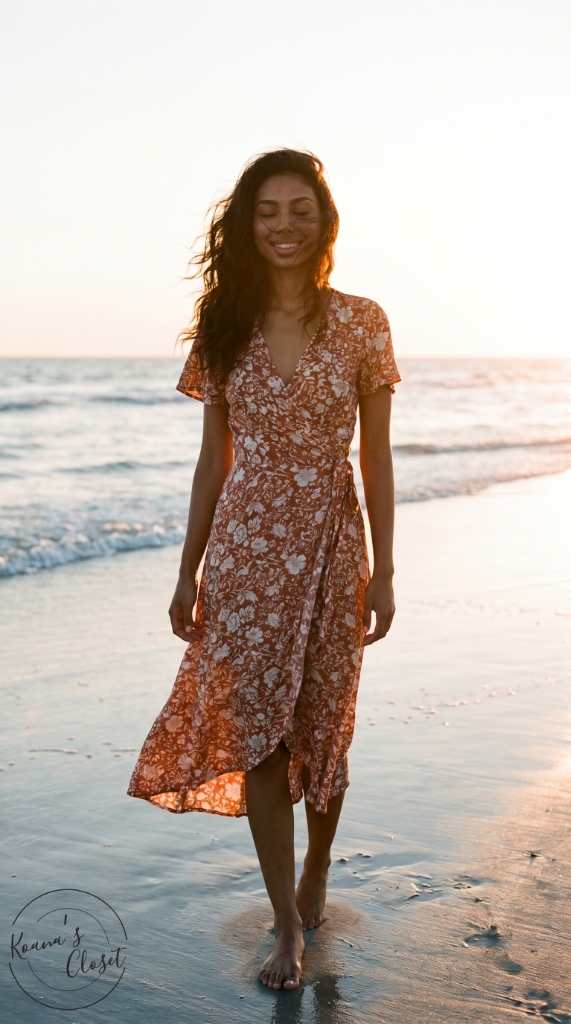
Kai Nalani grew up in Honolulu, Hawaii — the kind of place where your wardrobe is mostly whatever is comfortable, whatever moves well, and whatever survives salt water. Filipino and Hawaiian by blood, raised by a mother who believed in simplicity and a grandmother who wore flowers in her hair every single day, Kai never thought much about labels or trends.
She was a professional surfer by 19. Early mornings, long paddles, and the kind of sun-soaked exhaustion that makes you care deeply about what you put on your body. She didn't want stiff, expensive, uncomfortable clothes. She wanted things that moved with her, breathed with her, and still looked like she had her life together when she walked from the water into the world.
When she transitioned out of competitive surfing and moved to Los Angeles at 22, she brought that same philosophy with her. She started a small Instagram account — nothing planned, just outfit photos in morning light. Floral prints and linen. Effortless and real. Her smile in every single photo was the thing people kept commenting on. Not the clothes. Her joy.
It was that smile that would eventually change everything.
Chapter Two
She left a career in finance
to chase something real.
"I used to dress to fit in. Then I realized the whole point was to stand out."
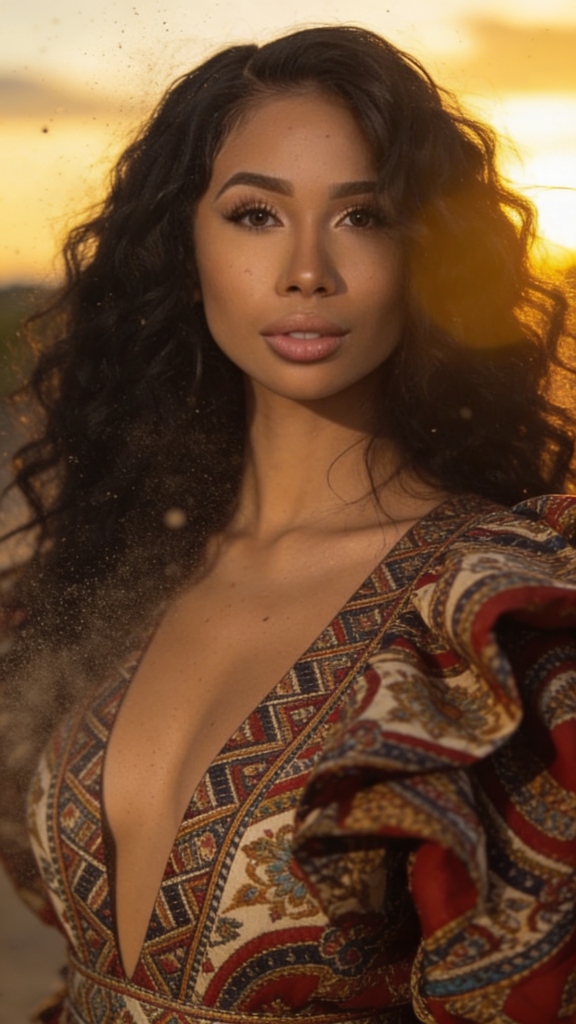
Maya Soleil was raised between two worlds. Her mother was Ethiopian — graceful, dramatic, deeply spiritual. Her father was Italian — loud, warm, with a love for beauty in all its forms. They met in Rome, moved to Miami, and raised Maya in a home full of music, argument, art, and incredible food. Summers were spent on Mediterranean coastlines. Winters back in Addis Ababa. She grew up understanding that the way you dress is a form of storytelling.
She was good at numbers. Sharp. Driven. She took a finance degree and landed at a consulting firm before she was 25, climbing fast and dressing the part — sharp blazers, neutral everything, professional to a fault. But something felt like a costume. Every morning getting dressed felt like putting on someone else's version of herself.
One evening after a particularly long week, she went out in a deep jewel-toned dress she'd found at a thrift store in Wynwood, gold layered on gold, her natural hair enormous and gorgeous. A stranger stopped her on the street and said: "You look like you know something the rest of us don't."
She quit her job the following month. Moved to Los Angeles with two suitcases and a bold certainty that fashion — real fashion, the kind that doesn't exclude people — was her language. She started styling locally, built a following slowly and genuinely, and one afternoon found herself commenting on a photo of a woman in a linen sundress laughing into the sun.
The woman's name was Kai.
"We didn't meet because we were looking for business partners. We met because we recognized something in each other."
— Maya SoleilChapter Three
She learned to sew before
she learned to read a runway.
"My grandmother used to say: the wrong outfit can silence you. The right one gives you a voice."
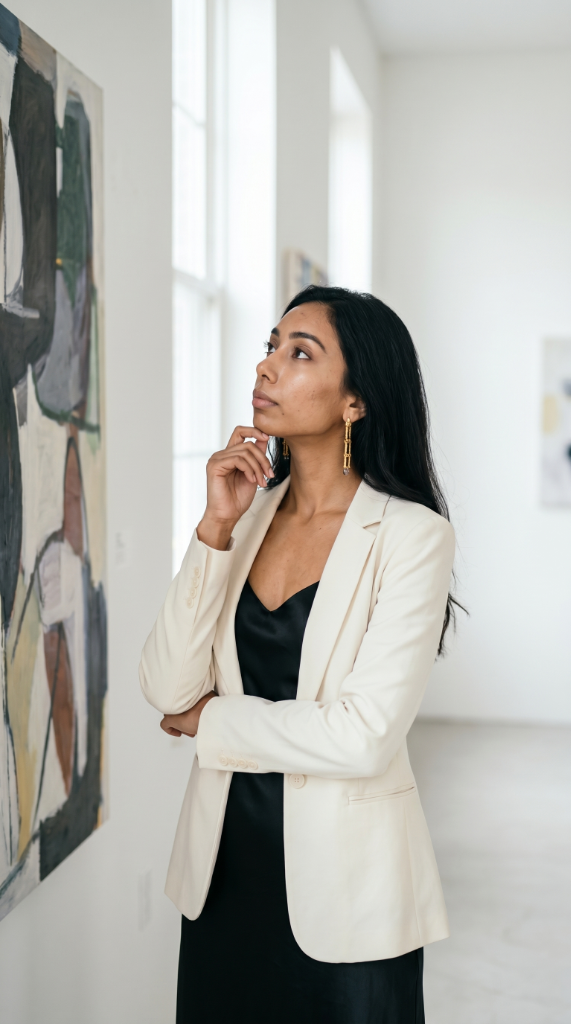
Sienna Mahal was born in Santo Domingo to a Dominican father and a Brazilian mother, and moved with her family to New York City when she was seven. Her grandmother — who stayed behind in the Dominican Republic — was a seamstress. Every summer, Sienna sat beside her at the sewing table, small hands guiding fabric, learning that every stitch was a decision. Every hem a statement.
She grew up in New York with one foot in the streets of Washington Heights and the other in the city's gallery district, where she got her first job as an assistant at a small contemporary art space in Chelsea. She was 21. She spent her days around painters and photographers and sculptors, absorbing the idea that the way something looks is never accidental — and the way something makes you feel is everything.
Her aesthetic was distinct from anything trending — silk slips over tailored blazers, statement gold against earthy tones, vintage luxury dragged firmly into the present. She had a name for it: intentional dressing.
By the time she relocated to Los Angeles, Sienna had a clear vision: she wanted to be part of building something. Not just wearing it. Not just styling it. Building it. She reached out to Maya — whose work she'd been following for months — and the two met for coffee in Silver Lake on a Tuesday that changed both their lives.
Within an hour, they were texting Kai.
Chapter Four
Three women. One group chat.
A brand born in notes apps.
For six months, Kai, Maya, and Sienna met weekly. Coffee shops, beach walks, Sienna's apartment in Echo Park. They talked about what was missing in fashion — not in the abstract think-piece way, but personally. The clothes that never fit right. The brands that made them feel invisible. The gap between how they actually lived and what the industry kept selling them.
They weren't designers by trade. But together they had something rare: Kai's instinct for ease and joy, Maya's eye for drama and expression, and Sienna's precision and vision. They started sketching a brand built on three things they all agreed on without debate — quality fabrics, real bodies, and clothes that felt like the person wearing them.
They called it Koana. A word that felt like warmth. Like the gentle movement between sun and shade. They wanted every piece to live in that feeling — the space between effort and ease, between dressed and undone, between who you are and who you're becoming.
They had the name. They had the vision. They had mood boards covering every wall in Sienna's living room.
What they didn't have was a website.
"We knew exactly what Koana was supposed to feel like. We just needed someone who could build the thing that showed the world."
— Sienna MahalChapter Five
Every great brand needs someone
to build the door.
"The brand was already alive. It just needed somewhere to live."

Koana had everything. The name. The aesthetic. The women behind it. What it needed now was a website — not just a functional one, but one that felt as considered as the clothes themselves.
A mutual friend connected the trio to a developer who went by Poppy. He wasn't in fashion. He was a builder — someone who'd spent years creating digital spaces for small brands, with an eye for what makes a person stop scrolling and actually feel something. He came in, listened more than he spoke, and at the end of his first meeting with Kai, Maya, and Sienna, opened his laptop and quietly showed them what Koana could look like online.
It felt exactly right. The warmth. The ease. The intention in every detail. He understood that a website for a brand like Koana isn't a storefront — it's an experience. He joined the team that week, and got to work building the thing that brought all of it to the world.
This is Koana's Closet.
Not a fashion house. Not a startup. A brand made by real people who believe that the clothes you wear should feel like you chose them — not the other way around.
How it happened
The road to Koana.
Kai moves to LA from Honolulu, starts sharing her style online — effortless, sun-soaked, completely genuine. Her smile goes viral before she knows what she's building.
Maya leaves finance, relocates to LA, and finds Kai's page on a slow afternoon. She sends a DM. Kai responds the same day. They meet for tacos in Silver Lake and talk for five hours.
Sienna arrives from New York with a vision and a portfolio of editorial work. Maya reaches out. They're on the phone with Kai before they finish their first coffee.
Six months of group chats, mood boards, and late nights in Echo Park. Koana is born — named for warmth, movement, and the gentle space between sun and shade.
A developer named Poppy joins the team. He builds the digital home Koana deserves — and the brand opens its doors to the world.
The site goes live. Real clothes, real people, real stories. Four voices, one brand. Built for women — and the men who appreciate a perfect tee.
What we believe
Clothes should feel like you.
Not a trend. Not an algorithm. Not someone else's idea of who you should be. Koana's Closet was built by people who wear what they sell — and believe every piece should make you feel more yourself, not less.
Shop the Collection